
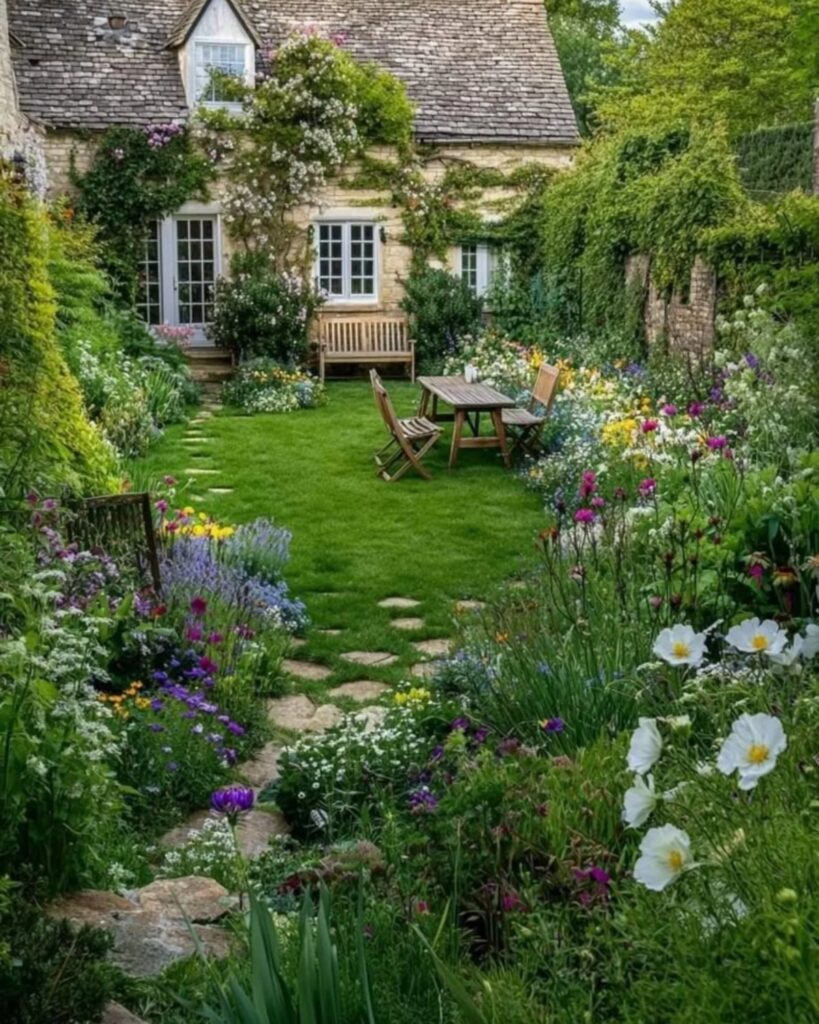
English garden ideas run from a DIY greenhouse built from salvaged windows to formal rose borders that take years to fill out.
What lands in your yard depends on whether you want instant structure or something that builds as your patience does.
1. Roses

No English garden reads complete without roses, and I would start with climbers if you have any vertical surface at all.
A brick wall or weathered door frame suits them exactly, and the density builds over two or three seasons rather than demanding instant coverage.
For my own zone and patience level, I would pick disease-resistant varieties first: Knock Out and Flower Carpet roses carry themselves without the spraying schedule that older types need.
David Austin’s ‘Gertrude Jekyll’ or ‘The Generous Gardener’ give the loose, layered look that reads English rather than suburban, and they repeat bloom through summer if you deadhead lightly.
Shrub roses fill lower borders where climbers would sulk; ground cover types handle slopes or the awkward strip along a fence. I would avoid any variety that needs hard pruning until you know your own tolerance for winter cleanup.
An archway covered with spectacular climbing roses is a signature feature of an English cottage garden. The arch adds structure and creates a beautiful focal point, while the roses bring color, nostalgia, and often a sweet fragrance that pollinators love.
2. Vegetable Gardens

Raised beds painted soft grey, set along a gravel walk and backed by hedging, let food production read as deliberate design rather than afterthought.
The height matters for drainage and for your back; the paint unifies the boxes with the house or the path, whichever sits closer.
Leafy greens and flowering chives carry enough visual weight to hold their own in a mixed bed. The mix depends on your sun: fruiting plants need the longest exposure, leafy crops manage with less.
Start with what you actually eat. A small productive patch beats an ambitious one left half-harvested in August.
3. Use of Color

I would think in layers by height and season. Low drifts of shorter bloomers at the front keep the path visible; taller spikes behind the arch frame the view from either direction.
Spacing matters more than any single accent: color needs breathing room or it mashes together at a distance.
Naturalistic planting takes its cue from meadows, amplifying what wild mixes do with texture and seasonal shift. Divide color by section if your space allows; a wall or short stretch of path between schemes lets each read clearly.
4. Use of Textures

Gravel underfoot, terracotta urns holding olive trees, boxwood spheres, lavender spikes, and hydrangea heads: each surface reads differently up close and at a distance.
The stucco wall and black-framed doors behind them give a neutral ground that lets the plant forms speak.
I would mix leaf shapes deliberately, not by accident. Rounded boxwood against broad hydrangea leaves against the narrow gray-green of lavender creates depth even before anything blooms.
The olive trees add height without heaviness; their silver undersides flicker when the wind moves them.
Terracotta weathers fast in hard winters. I would seal new pots or plan on replacement every few years in zones with real freeze.
5. Use of Statues

Four white classical figures on stone pedestals turn a mansion approach into a measured sequence; at smaller scale, a single piece does the same work.
Placement at intervals lets the eye rest; too many focal points compete and none of them land.
I would choose one material and stick with it. Painted stone weathers unevenly; natural stone or cast concrete in a single tone holds longer against the green surround.
The pedestal matters as much as the figure: it lifts the piece above the border’s tallest growth and separates it from the plants that will creep around its base.
Formal symmetry suits long straight paths. A single statue at a path’s turn or garden room threshold reads more intimate, better scaled to the yards most of us tend.
6. Create a Cozy Atmosphere

A stone fountain, a small table set for tea, two chairs tucked between hydrangeas and climbing roses: this is a garden room made explicit, bounded by walls and planting rather than by architecture.
Enclosure does the real work of making a space feel held; stone walls or hedges give you that whether the morning is misty or clear.
I would build seating against a wall or hedge first; the back matters more than the view for comfort, and a solid boundary behind you lets the garden open in one direction.
A water feature close enough to hear but not so close it splashes the pastries completes the sense of retreat.
"Garden rooms" need not be large. A single dividing hedge, a gap in tall planting, or an arch between zones marks the transition.
I would separate at least one corner for sitting, even in a yard measured in feet rather than acres.
7. Pathways

A path that curves out of sight turns a small yard into a place worth walking through.
Brick or stone pavers give the classic English look, though spaced flagstones with gravel between them let rain soak in where runoff is a problem.
The material matters less than the line: straight paths belong to formal gardens, but a wandering route, even one mown through grass, asks you to see what comes next.
I laid my own from salvaged concrete pavers, and the bends hide how short the run really is.
Check your soil drainage before you commit to a surface. A path that holds water grows moss in shade or becomes slick ice in winter.
8. Water Features

Moving water covers the noise from the road behind my fence better than any plant wall ever has.
A small stream between mossy stones, a basin on a pedestal, even a cheap recirculating fountain from the hardware store: the sound does the work.
Koi ponds look rich but need depth enough to not freeze solid and filters you will clean weekly. Birdbaths cost almost nothing and draw more species than feeders do.
I keep one on a stump where I can see it from the kitchen window.
Still water breeds mosquitoes fast. A fountain pump or a few drops of vegetable oil on the surface breaks the tension so larvae cannot breathe.
9. Edible Plants

Purple kale against pink foxglove is a combination I steal from every walled garden I visit.
English gardens never segregated food from flowers, and the annual budget goes further when the sage and chives earn their place at the table.
I tuck basil among the annuals and let nasturtiums trail from pots where they are pretty first, peppery second. Plant edibles that look good young, since you will harvest before they reach full size.
Your climate limits what overlaps in season. Where summers turn hot fast, lettuces bolt and become bitter before the roses peak.
Plan the swap.
10. Hedging

Boxwood shapes itself to whatever geometry you have patience for, and in winter it is the only green that stays.
Low hedges define beds so the garden reads as rooms even when nothing blooms. I planted mine from small nursery pots, spacing them at half their mature width, and waited for the wall to fill.
Shearing twice a year, after the spring flush and again in late summer, keeps the fuzz off.
For faster structure at half the labor, a simple stock fence softened with climbing clematis gives you privacy this season while the boxwood grows.
Evergreen clematis on wire is my choice where deer browse: they leave it alone and it greens in January.
11. Use of Structures
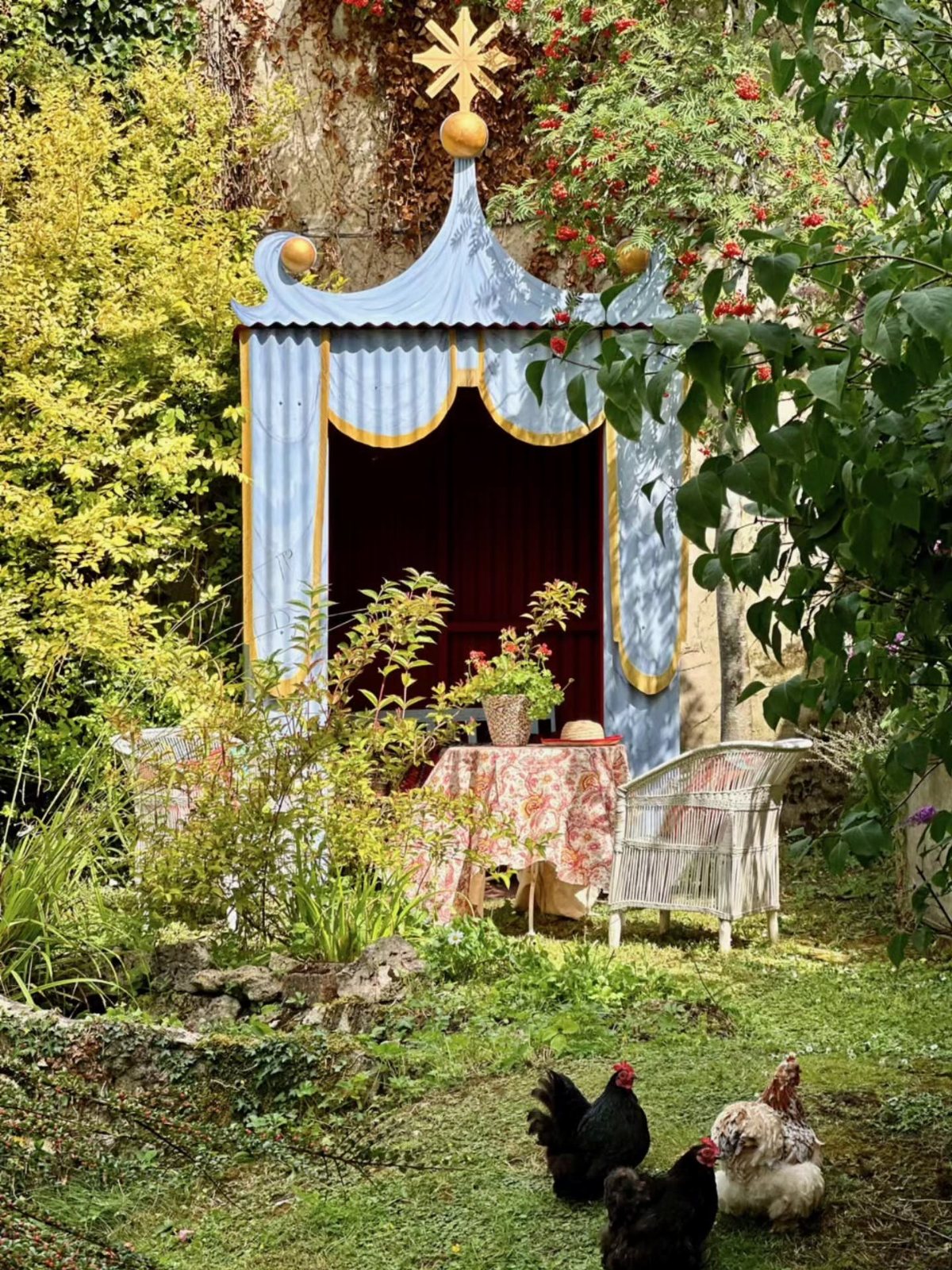
A painted pavilion in the back corner turns a flat rectangle of grass into a destination.
Arbors, pergolas, even a bench tucked where the path bends: these give the eye a place to rest and the feet a reason to walk.
Copper pipe salvaged from a remodel makes a trellis that goes verdigris in a couple of seasons and reads as old money for almost nothing.
Wood weathers fine if you let it, but painted structures ask for fresh coats every few years.
Trellises for morning glory need less muscle than arbors for wisteria. Match the structure to the vine, or you will be cutting back hard growth from a frame that cannot hold it.
12. Use of Arbors

A black iron arbor loaded with white bloom is the doorway I want to walk through every June.
Arbors mark where the garden begins and give climbing roses the height they want.
An arbor at the turn from lawn to vegetable beds, with a thornless Zephirine Drouhin trained over it, only needs the long canes tied in each April.
Wrought iron lasts decades but costs; pressure-treated wood rots where the posts meet soil unless you set them on gravel.
For a fast screen on a fence, espalier a fruit tree flat against the wires instead. The blossom is brief, but the architecture holds all year.
13. Cottage Garden Style

A cottage garden is the most forgiving way to get that English look without measuring or mapping.
I plant flowers, herbs, and even a few vegetables shoulder to shoulder so they hold each other up; hollyhocks lean on shrubs instead of stakes.
Patches three or four feet across give the lush, full impression without swallowing a small yard. Old standbys like foxglove and larkspur mix fine with zinnias or ornamental grasses if that is what you find at the garden center.
Let a few daisies and clover stay for the bees. Ivy on a fence softens the line and feeds butterflies through the season.
14. Use of Ground Covers

Low plants crawling over stone or packed between pavers do the weeding and watering for you.
I look for something that spreads to the edge you give it and no farther; Mexican fleabane, for instance, will drape over a rock without asking permission to take the path.
Shade, sun, and how much foot traffic the spot gets change the answer, so I match the plant to the hours of light and test it in a corner first.
Ground covers work hardest where digging a bed feels impossible or where the soil dries fast and you are tired of hauling the hose.
15. Foxgloves

Foxglove is the flower people stop to ask about. The spires rise well above everything else in late spring, and the spots inside each bell look hand-painted.
Self-seeders such as Dalmatian Purple or Camelot Rose will fill gaps on their own after a season or two, so I plant them where I want that colony effect and pull the ones that land in the wrong spot.
They are biennials or short-lived perennials, which means a patch needs fresh plants or new volunteers every few years. Digitalis is toxic, so keep it back from vegetable beds and anywhere a toddler explores unsupervised.
16. Layered Mixed Borders

A border with real depth needs three stories working at once.
I put small trees or tall shrubs at the back for height, mid-size perennials such as hosta or foxglove in front of them, and annuals tucked into gaps for color from July through October.
A metal obelisk or two breaks the horizontal line and gives clematis something to climb.
In a narrow yard this stacked approach buys you more planting room than a single row; just step the heights down toward the viewer so nothing hides behind its neighbor. Dwarf varieties keep the same effect in smaller beds.
17. Climbing Plants

Climbing plants turn a flat wall or bare fence into architecture.
I train roses or clematis up a trellis, an arbor, or wires stretched between eye bolts; the support needs to be sturdy, since a mature climber in leaf and bloom weighs more than you expect.
Peggy Martin is one I would pick for a beginner, a tough rose that survived Hurricane Katrina and still flowers heavily.
Place the trellis a foot or two off the wall so air circulates and you can reach behind to tie new growth.
The same idea works indoors if you have the light; a conservatory with glass and stone handles it well.
Design Principles
Nature does not draw straight lines, and an English garden that looks natural keeps that in mind.
I would let borders flow rather than holding them to ruler edges; bring a tall foxglove forward to lean over the path while something shorter peaks from behind. The mix reads fuller than the same plants lined by height.
Paths should bend even if they only wander a few feet. I would add a bench under the canopy somewhere along the route, placed so the sitter faces back into planting rather than out toward the fence.
Plant Selection
Year-round interest means stacking plants by calendar as much as by height. I would put in perennials for structure, annuals for the gaps they leave, and flowers that feed bees where I need fruit to set.
Bees in my yard head straight for the lavender, then the yarrow, the black-eyed Susans, and the asters.
Native plants earn their place by feeding the insects that belong here. A garden that only looks good is a missed chance; one that works for pollinators keeps itself going.
Maintenance Tips
How you trim sets the mood as much as what you grow. I shear boxwood twice a year for clean walls that define beds even in winter, but I let the cottage border run until something needs staking.
Topiary takes patience and steady hands; a naturally vase-shaped tree gives a similar outline without the hours.
Deadheading extends bloom on repeaters such as roses. I would skip it on self-seeders such as foxglove if you want the next generation.
Overgrowth in the right place reads as abundance, not neglect.
Creating Atmosphere
Stone, brick, or wood underfoot gives a courtyard the sense that it has been there longer than it has.
Water close enough to hear but not to splash turns a corner into a retreat. For evenings, string lights or lamps let the garden stay usable after sunset.
A metal pergola over the seating gives structure to drape them from and frames the sky.
Frequently Asked Questions
How do I make my backyard look like an English garden?
A path that disappears around a bend gives even a small yard the sense there is more to find. Add at least one enclosed corner for sitting, bounded by a hedge or wall so the space feels held.
What plants are good for an English garden?
Roses, foxgloves, lavender, and hydrangea are reliable choices that give the layered, seasonal look.
I would start with disease-resistant roses such as Knock Out or Flower Carpet, and add self-seeding foxgloves like Dalmatian Purple or Camelot Rose to fill gaps on their own.