
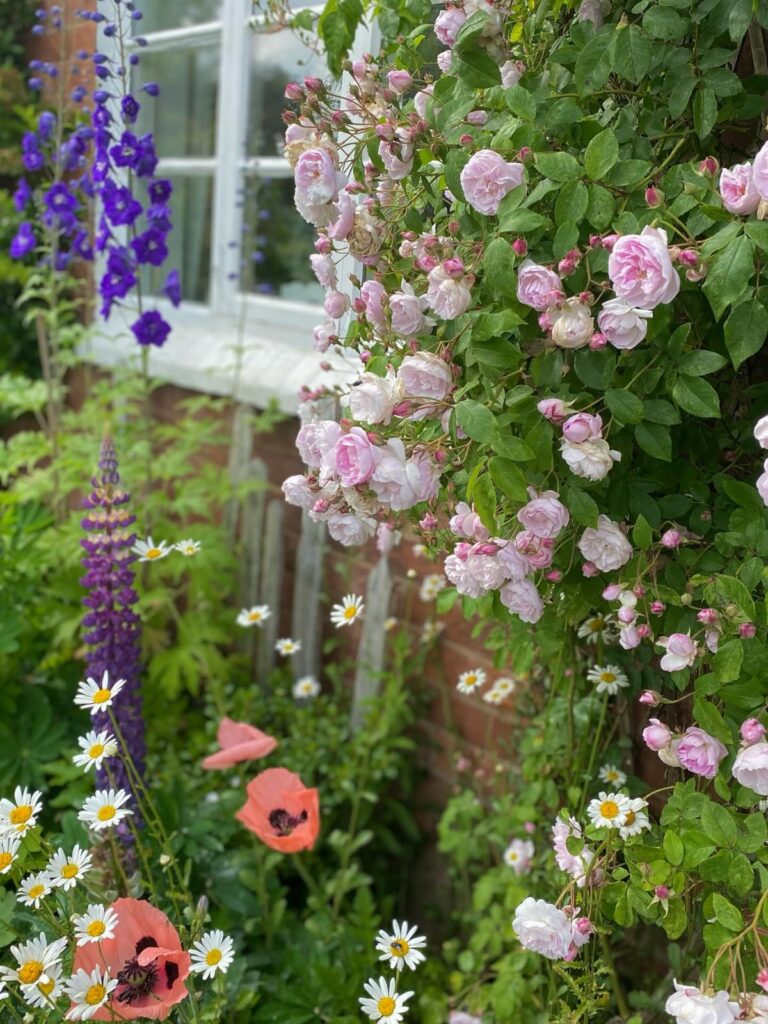
Cottage garden ideas run from a free plank on concrete blocks to a $300 greenhouse build and a cedar raised bed that costs half a season’s plant budget more than pine.
1. Incorporate Ground Cover

Low stone edges hold back creeping thyme or snow in summer, plants that spread flat enough to step over and thick enough to choke out weeds.
I set them between pavers and at the front of borders where bare soil would otherwise bake all summer.
Creeping thyme handles foot traffic and smells right when you brush it; snow in summer covers more ground faster with silver-gray foliage. Both want compost worked in at planting and arborist mulch while they fill in.
In my yard, thyme stays evergreen enough to look alive in March.
This suits anyone tired of weeding between plants on a half-day schedule. Ground cover looks spotty year one, decent year two, and only full by year three.
2. Mix and Match

Cottage gardens earn their look by refusing to sort plants into categories.
I pack annuals, perennials, herbs, and shrubs together so they lean on each other. Purple Rozanne geranium through red Super Hero rose is a pairing I keep returning to; the geranium tolerates heat and keeps blooming without fuss.
Let them twine and compete. The charm is in looking like no one planned it, which takes more planning than you’d think.
Fill gaps with urns, fallen logs, or a wattle fence to keep paths walkable. This style demands time more than money.
A neat yard person should skip it.
3. Colorful Flowers

Color in a cottage garden came originally from plants that worked for a living: edible, medicinal, or at least impossible to kill. That history still matters.
I pick long-blooming perennials that don’t need constant deadheading.
Verbena, gaura Belleza Dark Pink, and aeonium rosettes carry my beds through summer with maybe one cutback in winter. Choose bloomers that overlap, so something is always loud while something else is winding down.
Kitchen garden logic still applies. Nasturtiums and calendula earn their space; they look right and read as flowers to anyone who doesn’t cook.
This is for the reader who wants color without a part-time job. The cost is letting some plants reseed where they will.
As has already been said, the beauty of cottage garden ideas is that there are no rules.
4. Embrace Curves

Straight paths say formal garden; curves say you might find something worth walking toward. Flagstone, old brick, or even edged gravel works if the line meanders enough to slow a visitor down.
I laid bluestone once in a New York garden where the path had to bend around an established crabapple. The curve made the tree look intentional.
Wood chips or gravel need solid edging to stay in bounds, especially after rain.
The material choice depends on what you haul. Salvaged brick mixed with broken tile costs only labor and reads as older than the house.
A small yard benefits most: one curve can make tight space feel like a discovery. Flat yards need this most; sloped ones already read as interesting.
5. Add Vertical Interest
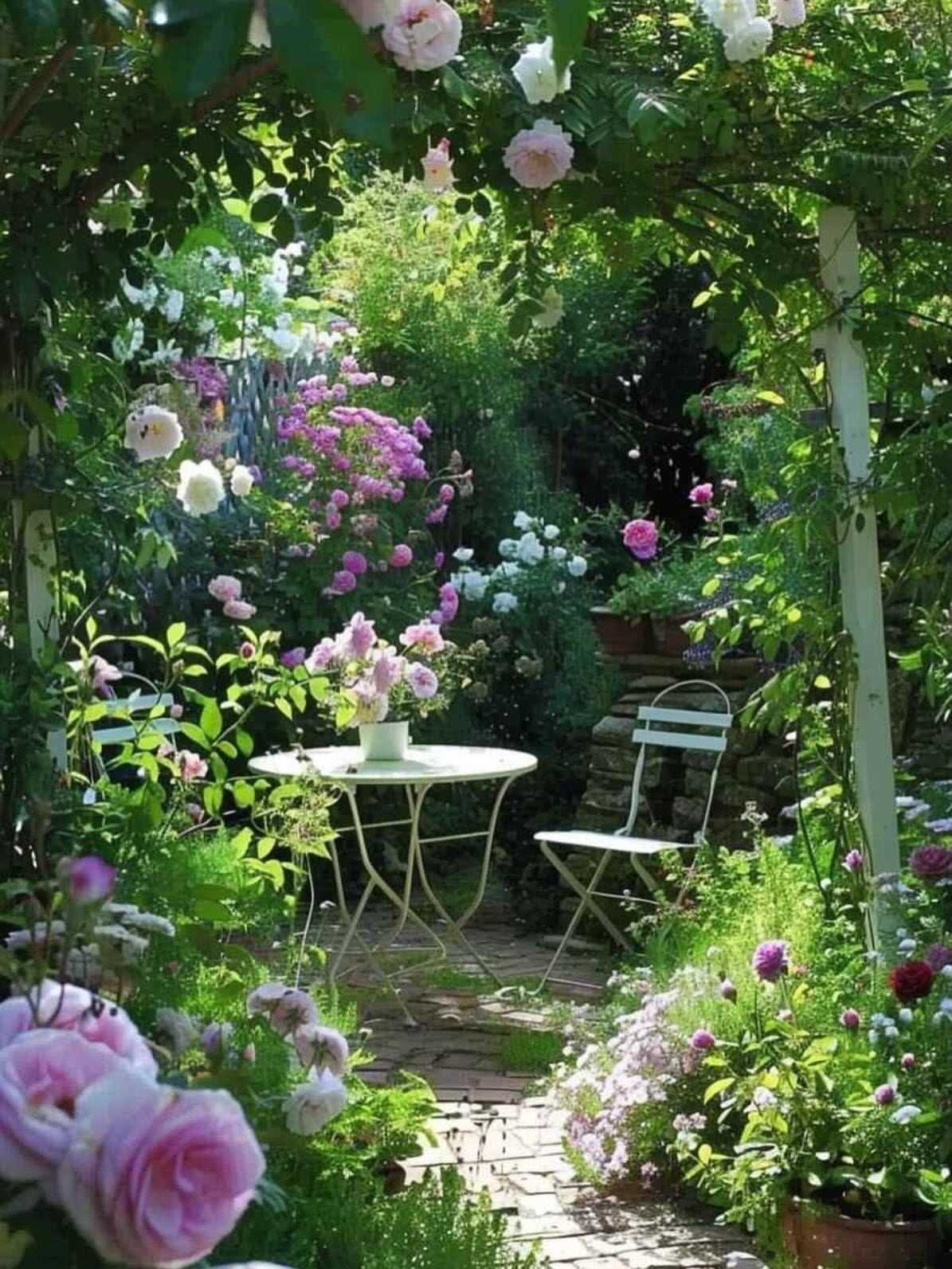
A white bistro table under a rose-covered arch is the vertical moment that makes a flat garden feel built over time. Trellises, arbors, or even a garage wall give clematis and climbing roses somewhere to go but up.
I have yet to plant my shed wall and I think about it every June when the garden hits shoulder height and stops. Rambling roses grow faster and cover more than standard climbers; clematis threaded through them extends the season.
The structure has to carry mature weight, so I use metal or thick posts, not thin lattice.
This suits renters too: a freestanding arbor moves with you. Yearly pruning is needed to keep paths passable.
6. Include Seating Areas
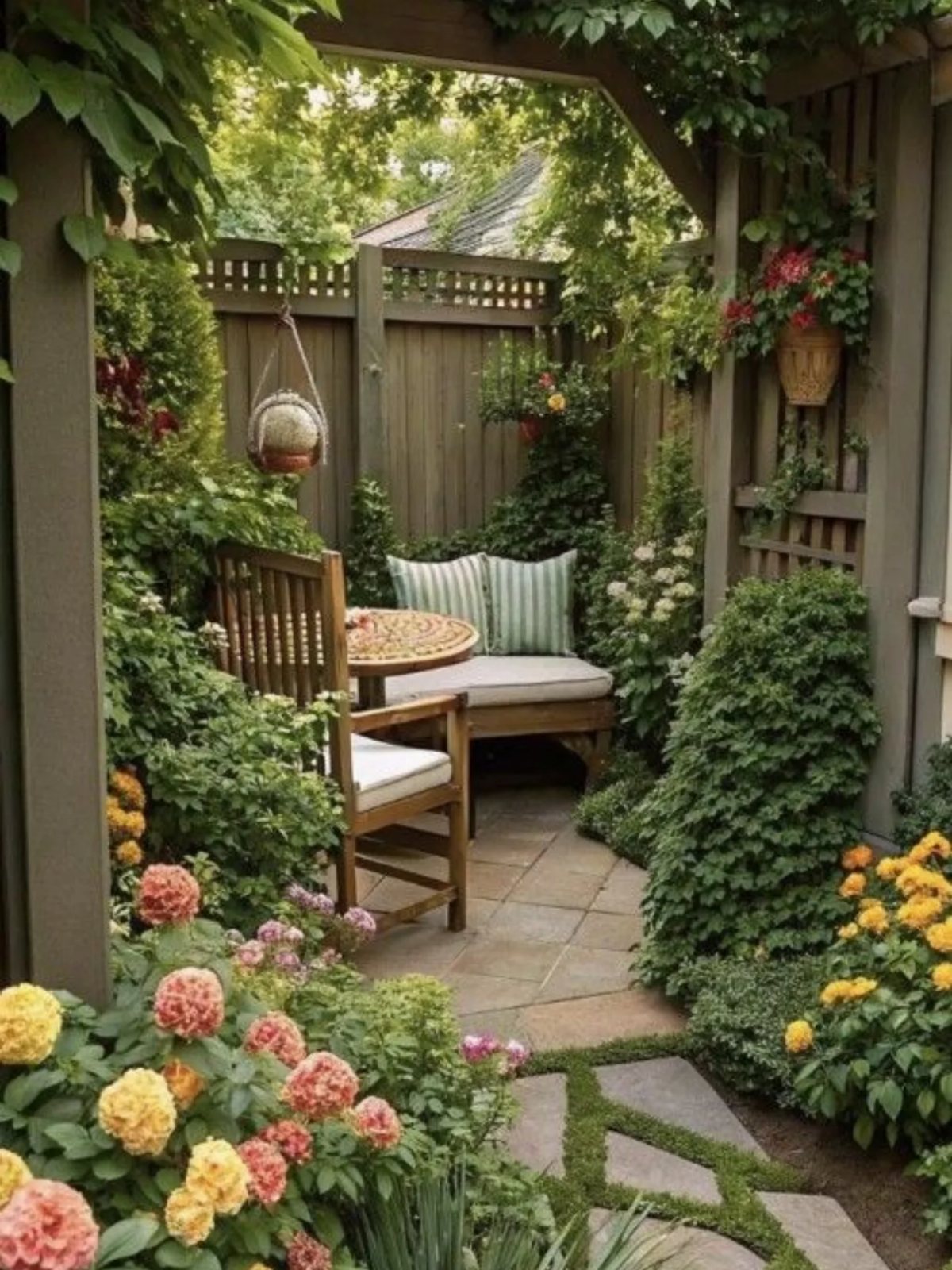
A seat tucked under hydrangeas and a leafy pergola is where the garden gets used instead of just observed.
I set benches at path turns or at the end of a curve so a person arrives without knowing the seat was waiting.
My own seating ranges from a plank on concrete blocks to a folding cafe table under a birch.
The plank cost nothing and lasts until the blocks shift; the cafe set came from a yard sale and lives in shade so the metal doesn’t brand a thigh in July.
Position matters more than furniture quality. A seat facing east catches morning light; one enclosed on three sides by plants feels found.
This is for anyone whose garden time is mostly a quick stretch with coffee. The limit is sun exposure on cushions; I store mine in a deck box.
7. Use Traditional Materials

Gravel underfoot, wrought iron overhead, weathered wood at the gate: these materials age into the garden rather than against it.
Stone paths keep their shape through wet seasons and dry ones, and terracotta pots develop that salt-stained skin no factory can replicate.
I would start with one material and let the rest gather. A crushed stone patio gives you the sound and the drainage; iron chairs or a wooden arbor come later as you find them secondhand or on sale.
Wrought iron rusts if you skip the oil, so budget for a wire brush and a half day each spring.
This suits the reader who wants the look to last past the first season and does not mind some weight in what she moves.
8. Celebrate Historic Features

A stone cottage with arched windows already carries more character than most gardens can add, so the planting should frame what is there instead of competing. The green door, the chimneys, the deep sills: these are your focal points already.
Work with the existing palette. The stone’s warm or cool tone decides whether you lean into pink mallows and white foxgloves or into gold yarrow and bronze fennel.
If you have no stone, a salvaged window or door propped against a fence does some of the same work at the cost of a drive to the ReStore.
This idea favors the patient gardener. New construction looks new; the charm builds as the plants soften the edges against old mortar.
9. ROSE

Roses at three to four and a half feet square fit a small yard without swallowing it. That spread is wide enough to interplant with lavender or catmint, narrow enough to walk around.
I grow shrub roses now after failing with the fussier kinds. Oso Easy Red Stripe carries pink, red, and white in one bloom, and the growers in Zone 6A I have followed treat them as ordinary perennials rather than divas.
A rusted arbor or a simple post gives them the vertical they want; without it, they sprawl and sulk.
The fragrance is the real reason, though. No other flower carries that far on humid July evenings.
10. Sweet Alyssum

Sweet alyssum stays low and spreads wide, which makes it a living edging for raised beds or the spiller in a container. It blooms from planting to hard frost, and the white variety holds through heat that wilts most annuals.
I use it to soften the line where bed meets path. The honey scent is strongest in late afternoon, so plant it where you pass coming home.
It reseeds lightly in my zone, not enough to weed, enough to fill gaps.
For a reader planting her first season, this is cheap insurance against bare soil.
11. Integrate Vegetables and Herbs

Lettuce and squash leaves among the flowers is not a compromise; it is the oldest cottage garden habit.
Rosemary and thyme at the path edge give you the scent on your way to the door and the sprig for the pot at dinner.
I plant basil where I would have planted coleus, chard where I would have planted hosta. Food plants carry their own color if you let them.
This suits the gardener who wants the yard to earn its keep and does not mind a little harvest dirt under her nails.
12. Install Raised Beds

Raised beds in dark wood, separated by gravel and joined by black metal arches, give the eye a place to rest when the planting goes wild. The structure is what makes the chaos readable.
Soil warms faster in a raised bed, drains better, and starts cleaner than what you inherited from the previous owner.
I would pick cedar over pine for raised beds; the cost difference is half a season’s plant budget but the labor is the same.
A birdbath at center is optional, though I have found that moving water or still brings in the birds that eat the pests.
For the gardener who wants cottage abundance without the back-bending maintenance, this is the practical core.
13. Add a Wildflower Meadow

A wildflower meadow turns the neat edge of your lawn into something that looks like it seeded itself. A corner strip of ox-eye daisies and cornflowers, once sown, now comes back thicker each June without replanting.
Sun and soil cleared of old grass are what matter; scratch the surface shallow, scatter the seed mix in late fall or early spring, and walk it in so the birds don’t feast.
A neglected side yard or even a wide container on a balcony works if you choose a dwarf mix.
Patience matters: year one can look thin and weedy, and you must hold off mowing until August so the annuals can drop seed.
For pollinator value on a tighter schedule, I’d add a few nursery-grown foxgloves or cosmos plugs in year one to fill the gaps.
14. Install a Water Feature

Still water catches light in a way that makes a small garden feel twice as deep. A pond at a path junction, stone-edged and sized for a few lily pads, suits most yards where a grand fountain would dominate.
Dig deepest at the center, line with EPDM rubber, and edge with flat stones laid to overhang slightly so the liner hides. A solar pump for a small bubbler needs no trenching for cable, though it quits after dusk.
If you rent or move often, a glazed ceramic birdbath on a pedestal gives the same reflective calm and travels with you.
The real cost is maintenance: skimming leaves weekly, draining and scrubbing before the first freeze, and accepting that mosquitoes will find it unless you add dunks or keep the water moving.
Simple is enough: no fish, no filter, just plants and a balance checked by eye.
Caring for High-density Plantings
High-density planting only works if you give plants room to reach their mature width without choking each other out. I check the label for spread before I buy, then space accordingly from day one.
Crowding cuts air circulation and invites the problems you were trying to avoid.
Watch how clumps grow through the seasons. Most need dividing every three to five years to keep their vigor.
I mark my calendar when a plant starts looking thin in the center or blooms less; that is the signal to split and reset.
Foliage color and texture matter more than flower when you are packing plants together.
A blue or variegated leaf repeated across sun and shade areas knocks the visual noise down and makes the garden read as one composition rather than a pile of separate plants.
Choosing the Right Plants
Color scheme is where cottage gardens either look intentional or look like a clearance rack. I group purples, whites, blues, and pinks in blocks rather than mixing every hue into every bed.
Similar colors placed together read as planned; scattered random reads as accident.
Foundation plants should carry the bed through winter. Evergreens at the back or center give structure when everything else has died back.
I use boxwoods in black planters as anchors that stay year-round.
Accent plants with a cool undertone, blue-leafed or silver, pull the eye without shouting. Solar landscape lighting at path edges extends the usable hours and makes the color choices visible after dinner.
A real cottage border mixes shapes and jobs the way an old kitchen garden did: tall spires behind, low herbs up front, something edible tucked in where you can reach it. Edible, medicinal, and purely ornamental plants belong together.
The gardener who wants only display flowers should look elsewhere; this style grew from utility.
Maintaining a Cottage Garden
Low-maintenance cottage gardens depend on picking the right plants from the start, not on wishing later. Catmint, daylily, foxglove, hydrangea, iris, lilac, stonecrop, and yarrow handle neglect better than most.
I grow catmint at path edges where I want soft color without staking or deadheading.
Native plants need less intervention than imports. Black-eyed Susans, purple coneflowers, and Shasta daisies survive from Zone 3 to Zone 9 with minimal attention.
Spirea, weigela, and potentilla shrubs bloom for months and rarely need pruning into shapes.
Daffodils and tulips go in the ground the fall before, so they are already up and fading by the time the perennials push through. Self-seeding annuals, zinnias, marigolds, and cosmos, fill gaps without replanting.
I plant three to five of each variety in a grouping, spacing perennials 12–18 inches apart. That density shades out weeds once the bed fills in.
Incorporating Wildlife
Pollinators need the right flower structure, not just any bloom. Double flowers are useless to bees; the insects cannot reach the center and many doubles are sterile.
I skip them entirely in favor of singles and open-faced varieties.
Geranium Rozanne and lavender at path edges feed summer bees in small spaces. Bumble bees come out colder than honeybees or butterflies, so they need flowers that open early, before the main rush of bloom.
Hellebores, cyclamen, primroses, crocus, lamium, galanthus, eranthis, and winter-flowering clematis carry them through late winter and early spring.
Borage refills its nectar every few minutes, so bees return constantly. The flowers also drop into drinks.
I plant it where I will brush past and notice the activity. Moving water, still water, and plants at staggered heights turn a garden into habitat rather than just decoration.
Frequently Asked Questions
What is a good layout for a cottage garden?
Winding paths and dense plantings give a cottage garden its natural, unplanned look. I would add one structural element, like a raised bed or arbor, to keep the eye from getting lost.
What is the rule of three in cottage gardening?
The rule of three means planting in groups of three or more of the same variety so the planting reads as intentional rather than scattered.
I pack plants together so they lean on each other, and grouping repeats a color or shape enough that the eye picks it up.