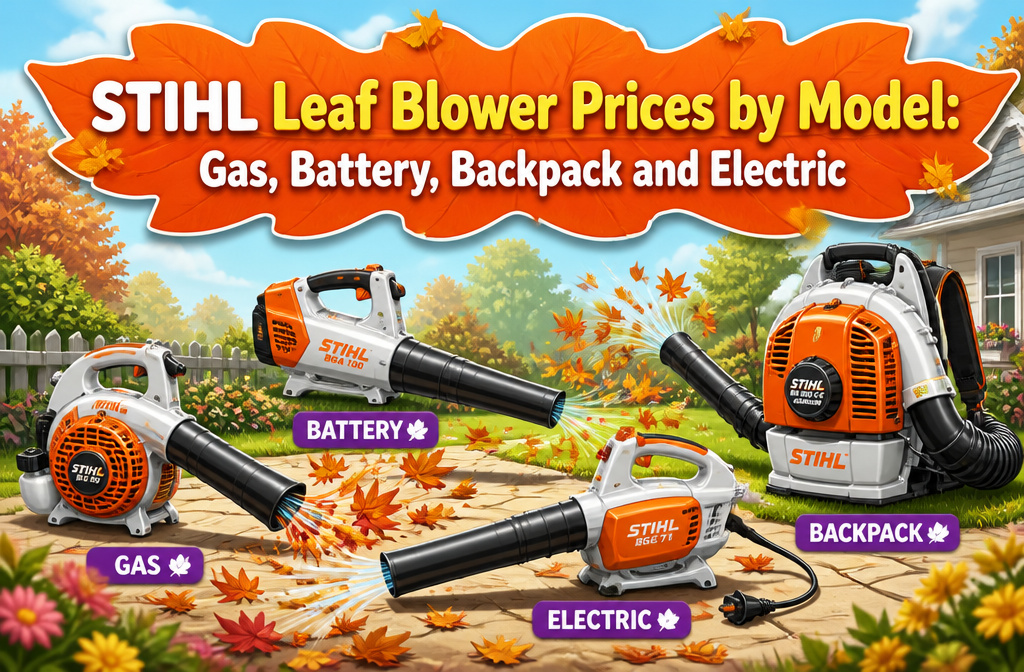
STIHL leaf blowers range from $110 for a corded electric to $749.99 for the BR 800 C-E Magnum backpack, but the price on the tag rarely matches what you actually pay. Battery models like the BGA 100 list near $700 yet need another $200–$300 in batteries and chargers before they will clear a single leaf, while a gas handheld such as the BG 50 leaves the store ready to run at $179.99.
BG 50 and BG 56 C-E

The BG 50 sits at $179.99 and weighs the least of any gas blower STIHL makes. That 27.2 cc engine puts out 412 cfm, enough for a small patio or a strip of lawn where the leaves are dry and the job is quick. I have watched someone half my size start one on the third pull, then stop after ten minutes because the vibration and the noise wear thin faster than the work itself. For a yard under a quarter acre and a body that does not mind the old routine, the BG 50 is the cheapest way into a STIHL gas blower.
The BG 56 C-E adds $60 and the Easy2Start system. The C-E means "Comfort, Easy2Start," which translates to a spring-assisted pull that takes about a third of the effort. Same 27.2 cc displacement, same general frame, but the starting procedure is simplified enough that I have seen it recommended for anyone whose shoulder or grip makes a hard pull a genuine barrier. At $239.99, the question is whether you pay the premium for the mechanism or save the money and build the tolerance. For a season or two of weekend use, the BG 50 keeps cash in the tool budget. For a household where multiple people share the blower and one of them struggles with the cord, the C-E earns its price in fewer stalled mornings.
BG 86 C-E

At $349.99, the BG 86 C-E sits almost exactly double the BG 50’s price, which raises the obvious question of what that extra $170 buys. The air velocity steps up noticeably, and STIHL lists it as the handheld built for speed: quickly clears all areas of leaves or grass cuttings. That is the job description, not a promise.
The C-E suffix matters here. It means Easy2Start, which I have come to read as "the pull cord will not make you hate your Saturday." More useful long-term is the cruise control throttle. Holding a trigger for forty minutes turns your hand into a claw; setting a speed and letting the blower carry it saves that. The anti-vibration system does similar work on your arms. I have handled enough gas equipment to know that two-stroke vibration at full tilt will numb your hands inside of ten minutes if the mounts are cheap.
Quickly clears all areas of leaves or grass cuttings
So this is the line: if your property runs past what a basic handheld can do in a single battery of effort, but you are not ready to strap on twelve pounds of backpack and hose, the BG 86 C-E is STIHL’s last stop before that jump. The weight and bulk of a backpack start making sense when you are doing this weekly or covering half an acre. For the rest of us, this is the handheld that tries to postpone that decision.
BR 200 and BR 350 Backpacks

The BR 200 at $409.99 sits above the BR 350 at $350.00, a price inversion that only makes sense once you pick them up. The BR 200 runs lighter and better balanced, built for residential users who wear a blower for twenty minutes and want to forget it’s there. The BR 350 carries more displacement and air volume, the kind of muscle that pays off on larger properties or when you’re out there long enough to empty a tank twice.
Both land in the 21–25 lb range, which sounds like a lot until the harness takes over. The straps shift weight onto your hips and off your shoulders, and that changes everything. I watched my neighbor try a handheld for an hour, then switch to a backpack the next fall; the difference in what he could finish in a morning was the difference between calling it done and actually being done.
If your yard is small and your sessions are short, the BR 200’s balance wins. If you’re covering ground where leaves pile faster than you move, the BR 350’s cheaper price and bigger output are hard to argue against.
BR 600 and BR 700 X

The BR 600 sits at $549.99 and earns its keep on landscaping crews for a reason. Its 4-MIX engine moves enough air to clear wet, matted leaves off turf without the operator doubling back. For a homeowner with a quarter-acre and a few maples, this is almost certainly overkill. The weight sits on your hips and shoulders, the fuel mix adds a maintenance step, and the noise means ear protection every single pull.
Step up to the BR 700 X at $729.99 and the extra money buys two things that matter: air speed pushed to 196 mph and a tube-mounted throttle that lets you dial output without taking your hand off the tube. The X denotes that side control, and it matters when you’re working around beds where full blast would scatter mulch into the lawn. The 64.8 cc engine and 912 cfm output put this in a class where most residential jobs finish faster than the operator’s stamina gives out.
So who should actually buy here? A homeowner with a wooded half-acre or larger, or anyone clearing multiple properties in a single weekend. The BR 700 X also makes sense if you already own a BR 600 for work and want the directional control for detail passes without swapping machines. For the typical $500-800 annual yard budget, both blowers represent a multi-year tool investment rather than a seasonal purchase. The BR 600 will finish any residential job; the BR 700 X finishes it with less stopping and less hand fatigue. Whether that difference is worth $180 depends on how much of your fall is spent holding a throttle wide open.
BR 800 C-E

The BR 800 C-E Magnum sits at $749.99, the price ceiling for every leaf blower STIHL sells. That buys a 79.9 cc 4-MIX engine pushing 912 cfm at a max air velocity of 230 mph, the highest in the lineup and roughly 20% more power than the BR 700 beneath it. At 23.1 lbs dry, this is not a machine you sling over one shoulder for ten minutes of patio work.
STIHL still stocks it through consumer dealers, not just commercial accounts, because a certain kind of homeowner actually needs it. I am thinking of the place I used to walk past on a gravel road: five acres of oak and hickory dropping leaves from August through February, wet layers matting on long driveway loops. For that property, a handheld or even a mid-size backpack means hours of stalling, refueling, and raking what the wind rolled back. The BR 800 C-E clears it in passes.
The C-E Easy2Start matters more here than on smaller models. A cold 79.9 cc engine with a traditional pull cord is a workout; the assisted start takes enough resistance out that one person can fire it up without bracing the frame against a truck bumper. The multi-function handle lets you dial force down for gravel paths so you are not spraying stone into lawn beds, then open it full for the pasture edge. Two-year warranty either way, residential or commercial, which tells you STIHL expects the engine to outlast the abuse either user hands it.
Who should skip it? Anyone under two acres with paved paths and a tidy lawn. The BR 800 C-E is overkill for that, and the weight becomes a penalty you feel by minute forty. But for large properties with heavy, wet debris and months of leaf drop, this is the blower that makes the job finite.
BGA 30, BGA 50 and BGA 56

The BGA 30 sits at $119.99 for the tool alone, or $189.99 as a set with two AS 2 batteries and an AL 1 charger. That bare-tool price makes it the cheapest entry into STIHL’s battery line, though the AS 2 batteries are smaller than what the larger models run on and won’t swap upward.
Step up to the BGA 50 and you’re at $199.99 for the set, this time with one AK 20 battery and the AL 101 charger. The BGA 56 lists at $199.00 — exactly a dollar less, and sold as the tool alone. Both use the AK battery platform, which is the upgrade path here: the AK 10 runs about 9 minutes, the AK 20 about 20 minutes, and the AK 30 stretches to 30 minutes. Those battery prices add $70 to $130 on top, so the set pricing matters if you don’t already own a charger.
The fifty-cent question is why the 56 costs less than the 50. The BGA 50 set includes that AK 20 battery and charger; the BGA 56 at $199.00 is tool-only, so you’re buying into the same battery family but starting from scratch on power. The 56 also gives up a touch of weight and convenience for that slight spec edge in runtime compatibility. For a first purchase, the 50’s set bundle usually wins. For someone already sitting on AK batteries, the 56’s stripped price is the smarter move.
BGA 100, BGA 160 and BGA 250

The BGA 100 lands at around $700, which is a steep climb from the entry battery models. That price gets you professional-grade air speed, 170 mph, and compatibility with STIHL’s backpack battery system. Run time stretches from 21 minutes on a small AP 100 battery in boost mode up to 395 minutes with the AR 3000 backpack battery at level 1. For someone working multiple properties or a large yard, that swap changes the whole day.
STIHL does not list standalone prices for the BGA 160 or BGA 250. The BGA 160 Set, which includes the AP 300 S battery and AL 301 charger, runs $649.99. The BGA 250 lists at $329.99 as unit only, though that figure sits oddly against the 100’s pricing and may reflect a different battery platform or promotional positioning.
Battery technology at this tier costs more than comparable gas power. The BGA 100 alone, without any battery, already exceeds the BR 600 backpack blower‘s $549.99 price tag. You pay for the quiet operation, the lack of fuel mixing, and the flexibility to scale runtime with larger batteries rather than refueling. Whether that premium makes sense depends on how much you value working without the noise and maintenance of gas, and whether you already own the batteries from other STIHL tools.
BGE 61 and BGE 71

The BGE 61 sits at $110, the BGE 71 at $120, and together they make up STIHL’s entire corded electric line. These are the cheapest blowers the company sells, and the only ones that need an extension cord to run.
That cord is both the limitation and the point. You gain unlimited runtime, no battery to degrade, and no gas to mix. The trade is range: you drag a cord across the yard, and every tree or chair becomes an obstacle. Noise drops noticeably with corded electrics, which matters if you share fence lines with neighbors or work early on weekend mornings.
The $10 gap between the two models buys the BGE 71 dual speed modes and vacuum compatibility with an add-on kit. The BGE 61 runs a single speed and stays a blower only. Neither will match the output of a gas handheld, but both hit 150 mph air velocity, enough for dry leaves on hard surfaces and light debris on turf.
STIHL keeps these in the catalog despite its heavy battery push because they fill a niche batteries still struggle to own. A corded electric asks no $200+ outlay for a battery and charger, carries no fade as the cell drains, and weighs less than anything self-powered in the lineup. For a small patio, a balcony, or a homeowner who simply refuses to manage another battery ecosystem, the tethered range is acceptable.
SH 56 C-E and SH 86 C-E

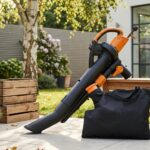
The SH 56 C-E runs $289.99 and the SH 86 C-E runs $399.99, and both are trying to be two tools at once. They vacuum and shred leaves through a metal impeller, then bag the reduced debris, or they convert back to a standard handheld blower. That metal impeller is the critical part; plastic ones on cheaper shredder-vacs deform when they hit a stick or acorn, but these hold up.
The bagging system matters more than I expected before I understood composting. Whole leaves mat down and take years to break down. Shredded leaves, reduced to something like a tenth of their original volume, decompose in a single season. The SH models pull leaves in, slice them against that impeller, and pack them into a shoulder bag. Empty the bag into a bin or pile, and you have finished the hard part of composting without a separate mower or string trimmer.
Switching between modes takes a few minutes. You remove the blower tube, attach the vacuum tube and bag, and reverse a latch on the housing. It is not instant, so the dual function works best when you blow leaves into a corner or bed, then convert and collect. For a small yard where you might blow everything into the woods and skip bagging entirely, the conversion step feels like unnecessary complexity. The SH 56 C-E at $289.99 is only $30 more than the dedicated BG 56 C-E blower, which makes the experiment cheap enough. The SH 86 C-E at $399.99 asks more of you; its stronger engine and better air filtration suit heavier use, but the price gap over a dedicated blower widens to about $110. For a typical residential lot under a quarter acre, the shredder function earns its keep only if you compost or if your municipality bans loose leaf piles.
What the Prices Actually Include

The price on the tag for a battery-powered STIHL is almost never the price you walk out with. That BGA 100 runs around $700, but the battery and charger sit in separate boxes with their own price tags. An AP 300 battery, the one STIHL recommends for that blower, and the matching charger can add another $200–300 to the total, pushing your real investment toward $900–1,000 before you’ve cleared a single leaf.
STIHL builds its battery tools around a shared platform, which is great if you already own an AP-series battery from another tool. The bare tool drops in at a lower entry point because the expensive part, the power supply, already lives in your garage. For newcomers, though, the bare-tool price hides the total cost of entry, and the surprise stings.
Gas models avoid this entirely. A BR 200 at $409.99 or a handheld unit near $179.99 leaves the store ready to run. Corded electrics work the same way, topping out around $140 with nothing extra to buy. The battery strategy only pays off on repeat purchases, which makes the math personal: one tool, and you’re subsidizing a platform. Three tools, and the shared battery finally starts returning your investment.
Gas, Battery or Cord

Gas blowers still carry the most raw power for large properties and heavy wet leaves, but that strength comes with noise levels high enough to run afoul of municipal ordinances in many towns. I have watched neighbors get cited in two separate California cities for running gas units past 10 a.m. on a Saturday; the decibel limits are real and enforced, especially in suburbs where houses sit close together. For a small yard on a $500–$800 annual budget, the maintenance burden matters too: mixing fuel, winterizing, the smell on your hands.
Battery units like the BGA 100 hit 170 mph and run as quiet as 64 dB(A) on some backpack models, which keeps the peace and lets you work earlier or later without complaints. The catch is runtime. Even with the recommended AP 300 battery, boost mode gives you just 16 minutes before you are waiting on a charger. Backpack batteries stretch that to 75 minutes, but the price climbs toward $700 and the weight shifts to your shoulders.
Corded electric at around $110 eliminates both the wait and the fuel, and the BGE 61 still pushes 150 mph. The limit is literal: your extension cord defines your range, and dragging 100 feet of cable around a patio gets old fast. For most small residential lots, battery fits the balance if you already own the platform; corded saves real money if your layout is simple and your outlets are close.
Weight and How Long You Can Hold It

A handheld blower at 7–12 lbs sounds manageable on paper, but the number changes after 20 minutes of sweeping a driveway. The BGA 57 weighs 7.8 lbs dry, and that forearm fatigue sets in right around the corner of the garage. Gas handhelds run heavier; the BG 56 C-E and BG 86 C-E sit in that upper range, and the vibration adds a numbness the scale doesn’t capture.
Backpacks like the BR 350 start at 21–25 lbs, which looks like double the trouble. The harness changes this: the weight rides on your hips and shoulders, not your wrist and elbow. After half an hour, that distribution matters more than the raw figure. Your hands steer instead of lift.
I used a handheld for two seasons before borrowing a backpack for a weekend. The mistake was assuming lighter meant easier for every job. For a 20-minute patio clear, the BGA 57 wins. For an hour moving wet leaves across a sloped yard, the BR 350’s weight disappears into the straps while the handheld becomes a pendulum you fight against. The lighter machine is smarter only when the job stays small.
Battery Runtime by the Numbers

Battery runtime is where the price of STIHL leaf blowers starts to tell only half the story. The BGA 56, a $199 model that weighs 7 pounds, runs as little as 9 minutes with the AK 10 battery or stretches to 30 minutes with the AK 30. That nine-minute figure matters because it is rarely the one shown in large type. Manufacturers lead with the upper number for a reason, and a shopper comparing models on headline runtime alone may bring home a blower that dies before the patio is half clear.
What those minutes mean in practice depends on throttle discipline. The BGA 100, a roughly $700 professional-grade blower, illustrates the gap clearly. Paired with the AP 300 battery, it runs 83 minutes at level 1 but only 16 minutes in boost mode. Most homeowners reach for full power by reflex, especially on wet leaves, and cut their effective runtime by four-fifths without noticing until the tool quits.
For a small yard or balcony, 20 minutes with the AK 20 may finish the job outright. Anything larger, and the math shifts toward buying multiple batteries or stepping up to a backpack battery system. The AR 1000 extends BGA 100 runtime to 225 minutes at low throttle, but that is a separate purchase and a different weight class entirely. I would rather own two mid-size batteries and swap than carry the single battery that matches their combined minutes, because leaves do not wait for a charger.
Noise Levels That Matter

Electric and battery STIHL blowers run quieter than their gas counterparts, a difference your neighbors will register before you do. The BRA 200 backpack battery model clocks in at 64 dB(A), low enough for early morning or evening cleanup without sending someone two doors down to their window. Gas handhelds like the BG 66 L carry the engine right in your hands, which keeps the noise closer to the operator but still pushes well past what most municipalities allow before 8 a.m. Backpack gas units move that same engine onto your shoulders, and because the exhaust sits higher, the sound carries farther across property lines than the handheld format suggests.
Most towns now have decibel limits or hour restrictions for gas blowers, and the trend is tightening. If your yard backs up to a bedroom window or a home office, the price gap between gas and battery starts looking smaller when you factor in when you can actually use the thing. For the $500–800 annual gardener, a blower you can run after dinner on a Tuesday without a complaint note on your door is worth planning around.
What I Paid and What I Would Now

I bought the BGE 71 electric blower three falls ago for around $120, which at the time felt like spending too much on something that plugs into a wall. The dual speed modes turned out to matter more than I expected; low keeps mulch in place on the garden beds, high clears wet maple leaves off the patio without pushing them into the lawn. The vacuum kit costs extra, and I never bought it. Raking still handles the beds, and the blower handles everything else.
For a small residential yard, that mid-range corded price held up fine. The BR 350 backpack runs $350 and breaks 200 mph, but that is professional power meant for ranches and orchards. After three seasons, my honest take is that the $120 tier is where the value sits for under a quarter acre. You lose the backpack comfort and the raw speed, and you drag an extension cord, but you also skip the fuel mixing, the weight, and the noise that gets a blower banned in half the neighborhoods I have lived in. If I were buying today, I would still hand over the same $120.
Frequently Asked Questions
How much do STIHL leaf blowers cost?
STIHL leaf blowers range from about $110 for corded electric models up to $749.99 for the BR 800 C-E Magnum backpack gas blower. Most homeowners land in the $180–$410 range for handheld gas or entry battery sets, while professional-grade battery models like the BGA 100 start around $700 before adding batteries and chargers.
What is the difference between gas and battery leaf blowers?
Gas blowers deliver more raw power for wet, heavy leaves and large properties, but they run louder, require fuel mixing, and face tightening municipal noise restrictions. Battery models run quieter, need no fuel maintenance, and let you work earlier or later without neighbor complaints, though runtime depends on battery size and can run as short as 9 minutes on the smallest cells.
What is the best STIHL leaf blower for residential use?
For small yards under a quarter acre, the BG 50 at $179.99 or the BGA 50 battery set at $199.99 cover most weekend jobs without overspending. The BG 86 C-E at $349.99 makes sense if you need more speed and cruise control for longer sessions, while the BR 200 backpack at $409.99 suits anyone who wears a blower long enough to feel handheld fatigue.
How long do STIHL battery blowers last?
Runtime varies sharply by battery and throttle setting. The BGA 56 runs 9 minutes with the AK 10 battery or 30 minutes with the AK 30. The professional BGA 100 stretches from 16 minutes in boost mode with an AP 300 battery up to 395 minutes at low throttle with the AR 3000 backpack battery. Most homeowners hit the practical limit somewhere between 20 and 30 minutes before needing a swap or recharge.
Are STIHL leaf blowers noisy?
Gas models run loud enough to trigger municipal decibel limits and hour restrictions, especially backpack units where the exhaust sits higher and carries farther. Battery and corded electric blowers stay much quieter; the BRA 200 backpack battery model hits 64 dB(A), low enough for early morning or evening work without drawing complaints from neighbors.