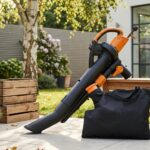
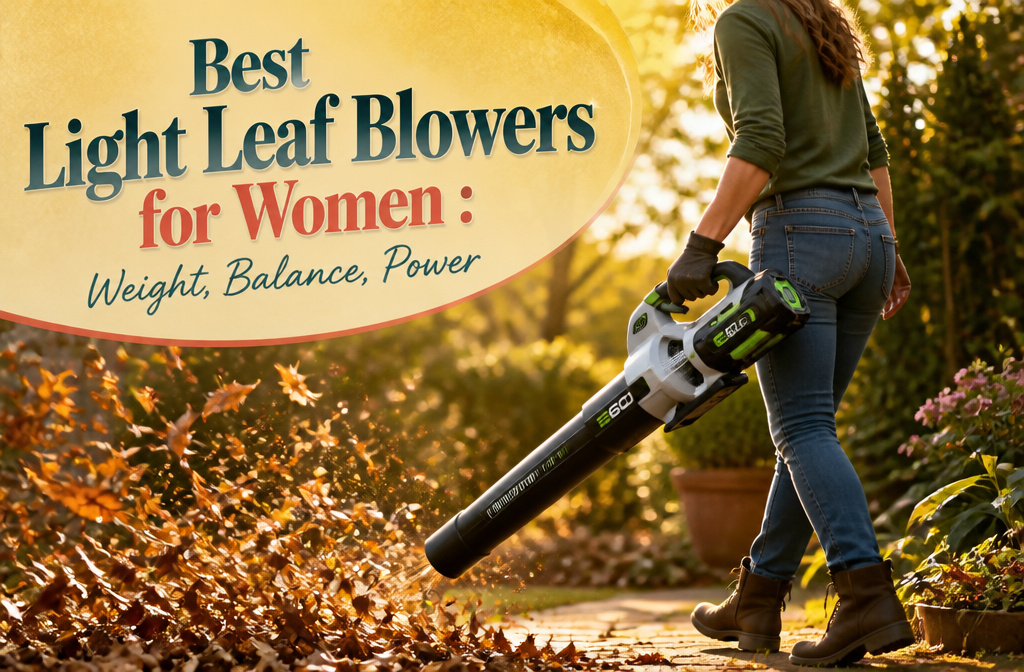
The Ego Power+ 650 CFM LB6504 is the light leaf blower for women that most yards actually need: roughly 27 minutes of run time on high, enough to clear a quarter-acre before the battery dies, with weight that sits low enough in the hand to keep the forearms from burning out on damp leaves.
That weight is still real. After twenty minutes overhead or angled under shrubs, the ten pounds add up, and the $280 price only makes sense if you are not just clearing a patio or dragging a cord across half an acre.
1. Best for Most Yards: Ego Power+ 650 CFM
The Ego Power+ 650 CFM LB6504 sits at the intersection where most yards actually live: enough power for damp, matted leaves without the arm fatigue that sends you back inside. Its roughly 27 minutes of run time on high covers a quarter-acre lot in one pass if you move with purpose, and the battery shields the air intake so your shirt stays where it belongs.
At about 10 pounds, the weight is real. After twenty minutes, the forearms know it, especially if you are working overhead or angling under shrubs. The balance is manageable because the weight sits low in the hand, but it is not nothing, and that is the trade for the power on tap.
Skip this one if you are tending a small patio or balcony, where a smaller tool does the job without the overhead. Skip it too if the $280 price stretches the annual yard budget thin, since a corded blower costs half as much and weighs half as much, though you drag a cord behind you.
"This Ego blower’s nearly 30-minute run time is among the longest of the cordless blowers we’ve tested. It has easy-to-use controls, a lot of power, and a precise airstream."
That runtime means you are not rushing against a dying battery, and the precise airstream lets you work around plantings without blasting mulch into the neighbor’s yard. The value tightens further if you already own Ego’s mowers or trimmers, since the batteries swap between tools.
2. Best for Big Jobs and Wet Leaves: Husqvarna Leaf Blaster 350iB

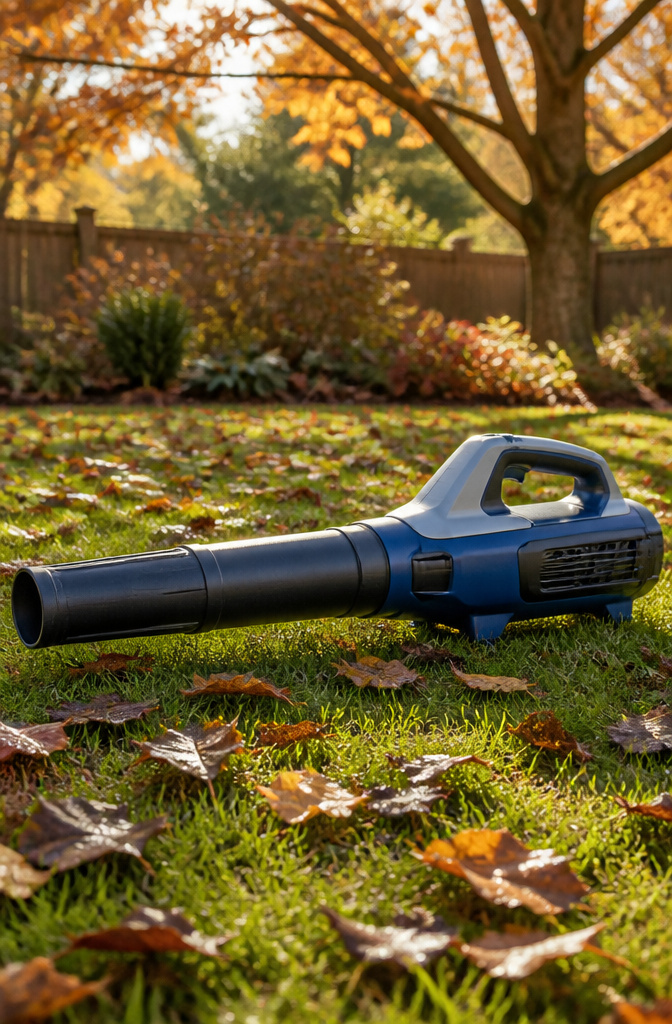
The Husqvarna Leaf Blaster 350iB is what you grab when the job outgrows the polite tools. At 10.2 pounds, it is not a light leaf blower for women in any casual sense, though the balance is good enough that the weight distributes once you are moving. The payoff comes in power: 30 minutes of runtime on high, and a boost mode that pushes through wet, matted leaves that would clog lesser machines. One nozzle end narrows the airstream to 146 mph for precision work; the other keeps the opening wide and adds a scraper tip you can dig under damp leaves packed against pavement.
That extra weight costs you over a full session. After twenty minutes, the 10.2 pounds accumulates in the wrist and shoulder in a way the seven-pound units simply do not. The noise is another factor, enough that ear protection stops being optional.
Skip this one if you are working a small patio or balcony, if your budget is tight at roughly $362–$379, or if you value quiet over raw output. It is also the wrong pick for anyone who does not face wet leaves or heavy debris regularly. For that user, the power is overbuilt and the weight is penance without purpose.
3. Best Budget Pick: Worx WG547 20V
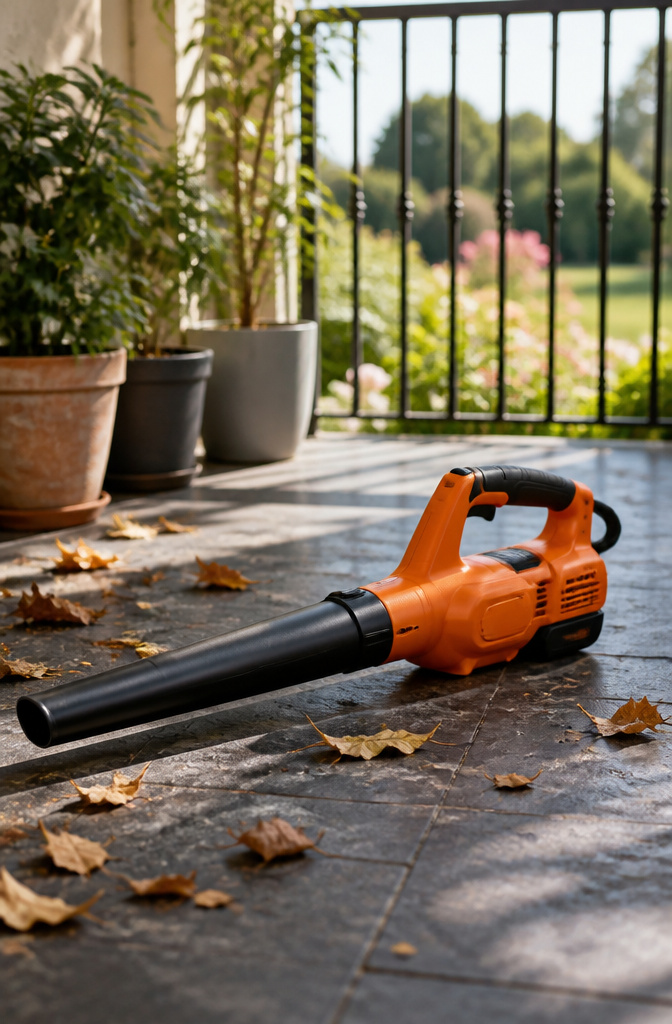
The Worx WG547 lands at 3.6 pounds with a 20V battery, and the whole package usually sells for under $100. That weight puts it among the lightest cordless blowers that still move enough air to matter. Runtime tops out around 45 minutes on low, which sounds generous until you realize how much of that you’ll burn through on anything beyond a patio or a small strip of lawn.
Two speeds keep the controls dead simple: low for dust and cobwebs off the deck, high for actual leaves. Assembly takes about a minute, snapping two tube pieces together. The battery is noticeably smaller than what runs on pricier models, and swapping in a spare means buying another Worx 20V pack, so factor that into the real cost.
This is where cheap gets honest. The WG547 handles dry leaves on pavement and grass without drama, and it even shifts wet leaves that sat through a light rain. What it won’t do is power through a heavy, sodden pile or clear a half-acre before the battery dies. Anyone with a large yard, thick ground cover, or trees that drop through November should look further up the price ladder. The air pattern is broader and less directed than premium blowers, so you spend extra time herding debris where you want it.
For a balcony, a small fenced yard, or quick cleanup before company arrives, the tradeoffs are tolerable. For real yard work, they’re not.
4. Best for Tiny Spaces and One-Handed Use: SNJORT Cordless
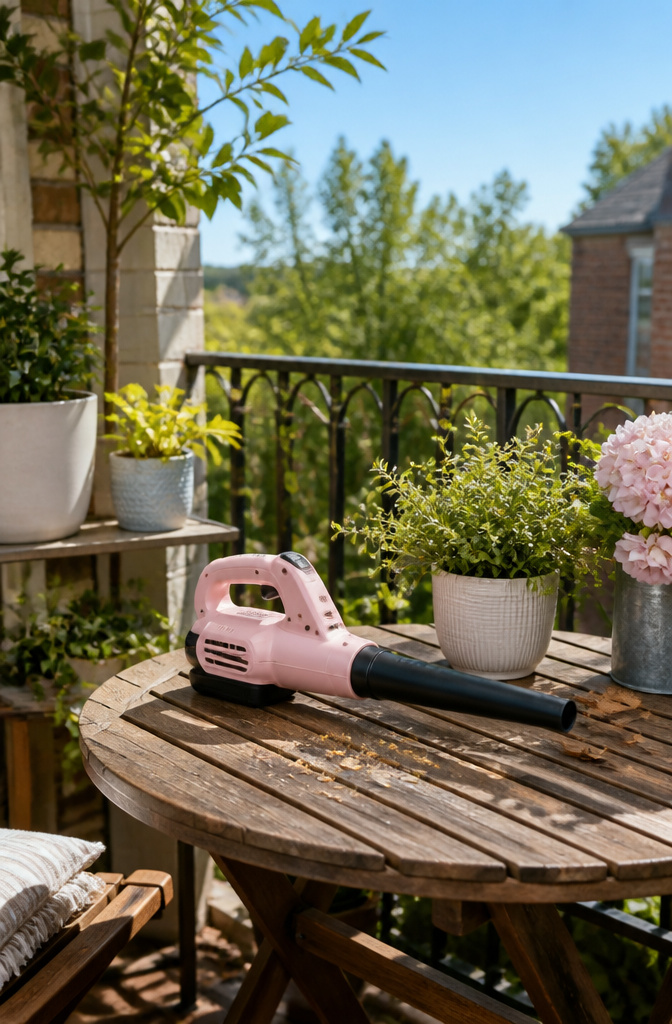
The SNJORT Cordless lands at 1.35 pounds, lighter than most power drills, and runs up to 50 minutes on a charge. That weight matters most when storage means a closet shelf or a balcony corner and every inch counts. One-handed operation lets you hold a coffee or a railing with the other, which sounds small until you try clearing porch steps before work.
Skip this one if you have actual yard work. Wet leaves on grass stall it out, and the shorter nozzle means bending to aim low. It moves dust, cobwebs, and dry debris fine, but leaf piles beyond a dusting need more motor. The noise runs higher-pitched than expected, though not enough to require ear protection, and the battery simply dies without warning rather than fading.
Two batteries ship with it, each charging in about 30 minutes with a red-to-green indicator. For a 15 square meter paved space or a weekly car cleanup, that cycle works. For anything resembling seasonal leaf drop, the weight savings cost too much in airspeed.
5. Best for Average Suburban Lots: Craftsman V20 RP
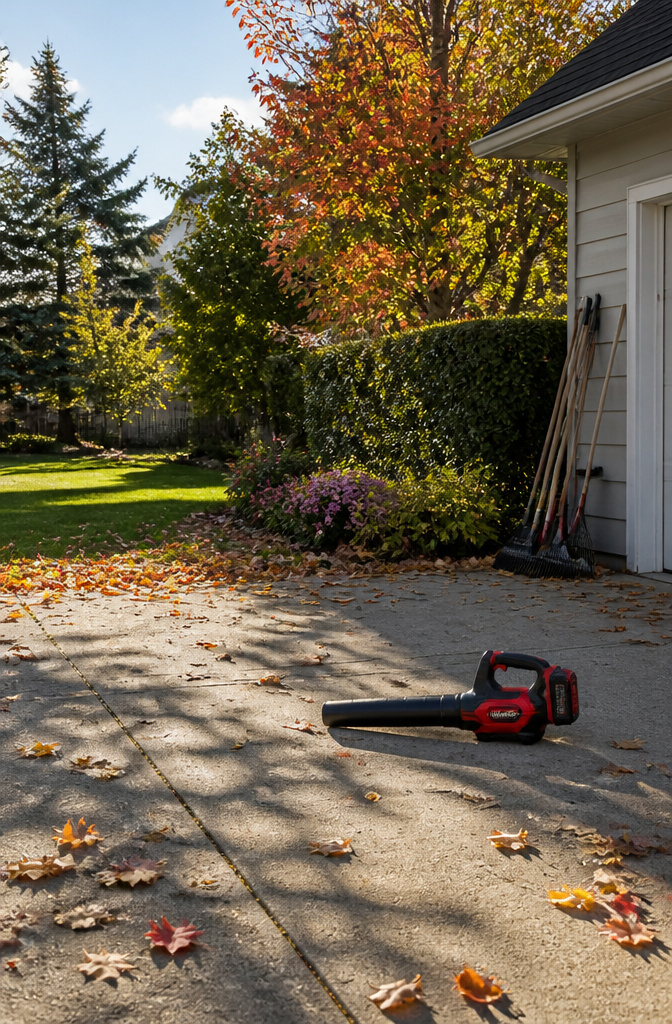
The Craftsman V20 RP sits at just under 7 pounds with a 24-minute runtime, which puts it squarely in the middle of the lineup. That weight is light enough to carry without strain but substantial enough that you know the motor is actually doing something. For a quarter-acre suburban lot with a mix of lawn, driveway, and a few flower beds, the balance works. You can clear the hardscape, push leaves off the grass, and finish before the battery dies.
Skip this one if you are working a small patio or balcony. A blower this size turns a 10-foot concrete square into a leaf tornado, and you will spend more time chasing debris than moving it. On the other end, anyone with a half-acre or more will find the 24 minutes frustrating. You get halfway down the long edge of the property and the battery blinks red.
The person who actually needs this model owns a standard 1970s-to-2000s subdivision lot: too much ground for a hand broom, too little to justify a backpack rig or a second battery. I have watched neighbors buy the cheapest blower at the hardware store, then borrow this exact Craftsman the following fall once they realize their bargain tool stalls on damp oak leaves. The V20 RP does not stall. It also does not apologize for being boring, which in yard tools is usually the point.
6. Best for Quiet Work: Milwaukee M18 Fuel
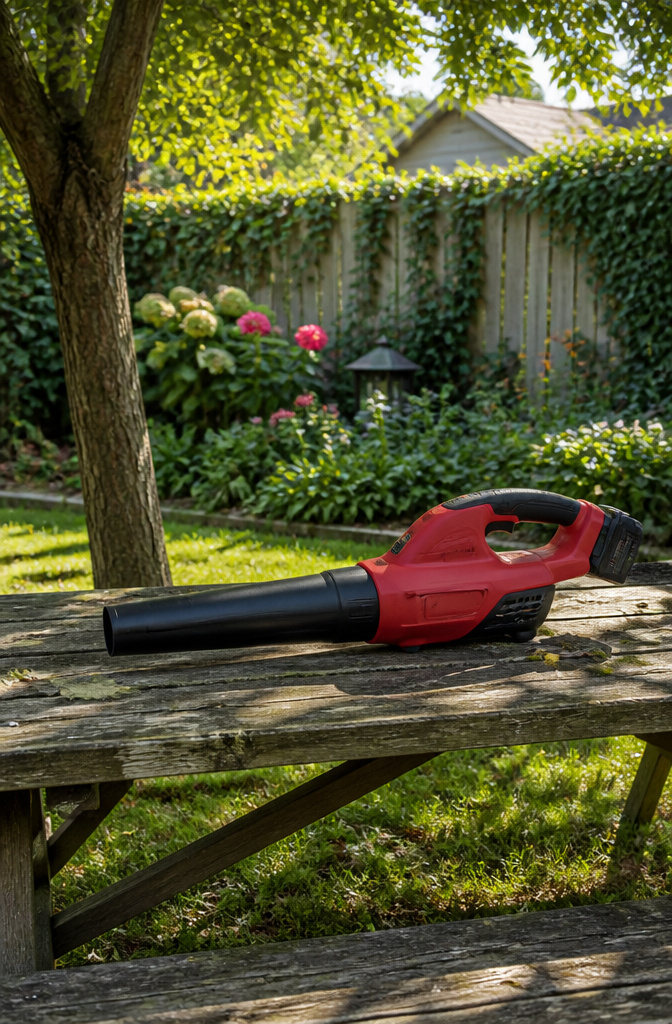
The Milwaukee M18 Fuel 3017-20 runs at 82.2 decibels, the quietest reading in the comparison table and a real difference you notice when working near neighbors or early on weekend mornings. At roughly 5.4 pounds with the smaller battery and 30 minutes of runtime, it carries light enough for a full clearing without the arm fatigue that sends people back to rakes.
The tradeoff is control. The airflow comes as a broad wall, strong on wet leaves and grass clippings but clumsy around bed edges or between delicate perennials. Sources describe it as tough to move leaves short distances or to a specific pile; for precision work, you would need a separate nozzle attachment. Skip this one if your yard demands careful direction, or if you want the absolute lightest option on the list. The weight sits comfortable, not minimal, and the power prioritizes coverage over finesse.
7. Best for Large Properties: Ryobi 40V HP Whisper Series
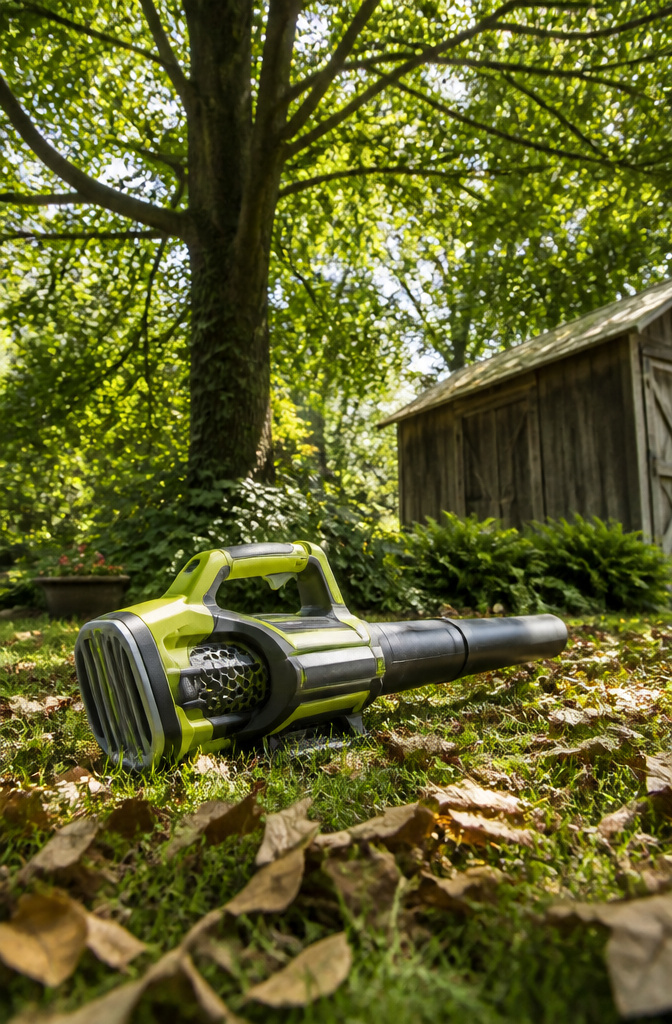
The Ryobi 40V HP Whisper Series sits at 10.6 pounds, which puts it in a different category than the one-handed tools. That weight buys real capability: 587 CFM moved a wall of leaves 25 feet without stepping forward, and the airspeed cleared packed debris from last season out of dense border weeds. For a half-acre or more with mature trees, those numbers mean finishing before the battery dies.
The catch is the wrist. Even with good balance, 10.6 pounds at arm’s length for twenty minutes on max power adds up. Anyone already prone to soreness after pruning or weeding should skip this one. Small-space users should too; the power is wasted on a patio or balcony, and the bulk turns tight corners into a fight.
Run time lands around 20 minutes at full throttle, so large-property work means either pacing yourself on lower settings or owning a second battery. The whisper claim holds for the power class, though "quiet" here still means hearing protection for the operator. Gutter cleaning on a ladder is awkward with this much machine; a roof with a gentle slope works better, or delegate that task to a smaller tool.
What Weight and Ergonomics Actually Matter
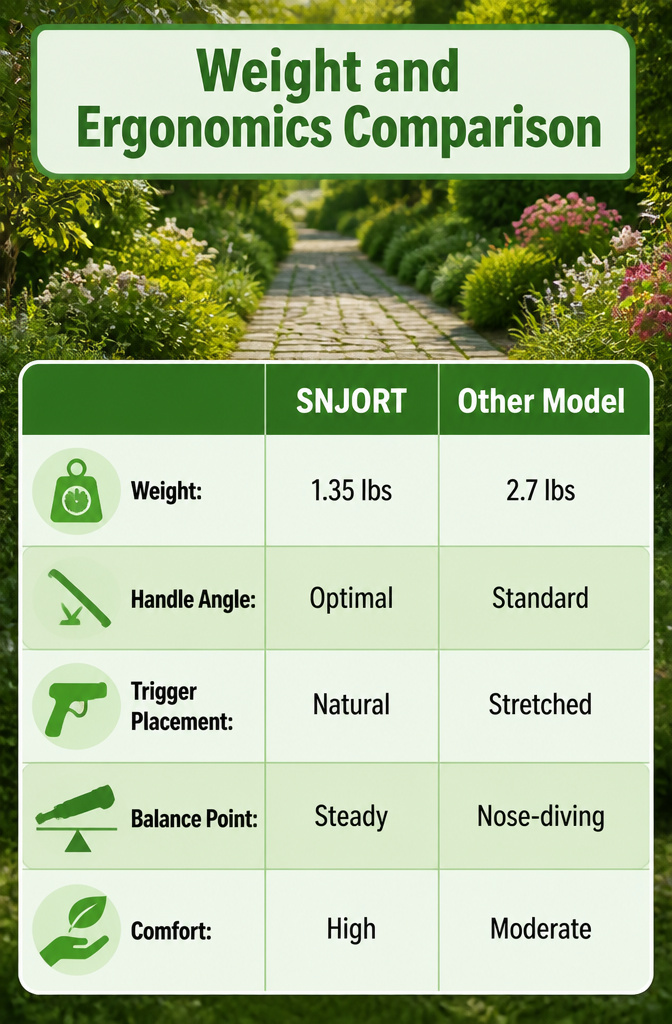
The SNJORT at 1.35 pounds sits at one extreme, roughly the weight of a power drill, and that number gets attention because it is easy to lift with one hand. Most women will find real comfort somewhere above that floor but well below the heaviest cordless models. A cutoff around three pounds keeps a blower from becoming an arm workout, though the number on the box only tells part of the story.
Handle angle matters more than ounces. A grip that forces the wrist upward or outward loads the forearm within minutes, while a slight downward tilt lets the machine rest against its own air thrust. Trigger placement decides whether you are stretching for the control or curling naturally around it. Balance point is the one you notice after ten minutes: a blower that nose-dives toward the ground fights you constantly, and the fatigue shows up in the shoulder, not the hand. The testers who ran these across lawns and cobblestone for years kept coming back to steady control over raw lightness, because a well-balanced three-pound tool beats a poorly balanced two-pound tool every time.
How Long Batteries Last in Real Use
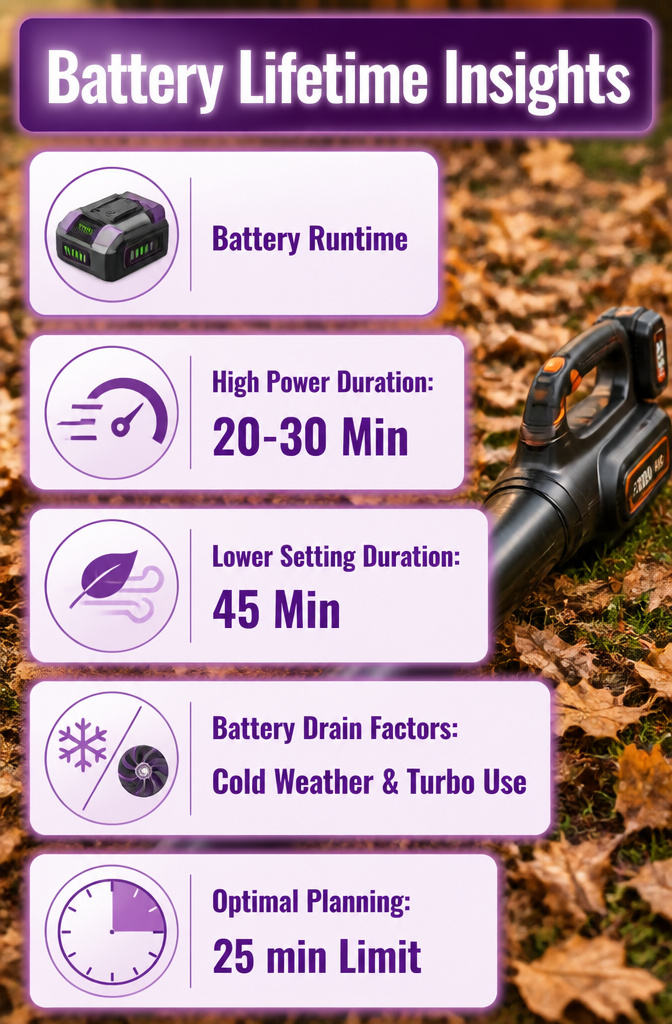
Manufacturers list runtimes that rarely match what happens in an actual yard. The numbers they print come from low-speed, no-load testing in controlled conditions, which is not how most of us clear leaves. In practice, 20 to 30 minutes on high power is what the typical cordless blower delivers before the battery dies.
The Worx WG547 stretches this further, hitting about 45 minutes if you drop to a lower setting. The SNJORT goes even longer, reaching roughly 50 minutes when you do not ask much of it. That gap between advertised and real runtime matters because wet leaves, stubborn patches of grass clippings, or cranking the speed to push debris off gravel all pull harder on the battery than the spec sheet assumes.
What drains batteries faster than expected is not always obvious. Cold mornings cut capacity. So does the turbo button most of us hit without thinking when a pile resists. The intake fan working harder against damp, matted material does the same. I plan sessions around a hard 25-minute limit on high, with a second battery already charged if the job is more than a patio and a strip of lawn. If you own a blower that accepts multiple batteries, like the Echo DPB-5800T with its two 5Ah packs, you get more runway, but that machine is a different weight class entirely and not what most people shopping for a light leaf blower need.
The Ego LB6504 tested at about 27 minutes on high, which sits right in that honest middle range. Its slower settings stretch to 200 minutes, though at that point you are barely moving air. The real planning trick is matching the power level to the task and quitting before the battery surprises you.
Noise and Neighbor Relations
Cordless blowers run quieter than gas, though 57 dB on the Milwaukee M18 Fuel still means ear protection is wise. OSHA sets its hearing-risk threshold at 85 dB, and even models well under that line make conversation impossible while they run.
The Milwaukee and Ryobi Whisper names sell the quiet angle hard, and the gap is real. A gas engine at full throttle sits nearer 100 dB, which is not just louder but a different kind of intrusion. Weekend mornings are when this matters most. A 9 AM start with a battery model might draw a glance from next door; the same hour with a two-stroke engine draws a phone call to the city. Many residential noise ordinances kick in at 65 or 70 dB measured at the property line, and gas blowers blow past that without trying.
I used to think the decibel rating was the whole story until I borrowed a neighbor’s gas unit one October. The sound carried differently, more aggressively, and the vibration traveled up my arm in a way that made the work feel heavier than it was. The battery models I tested later, including the Craftsman V20 RP on low speed, kept the peace with the houses around me and left my hands steadier afterward. For small lots where houses sit close, the quiet spec is less about your ears and more about whether you get to finish the job before someone complains.
Beyond Leaves: What These Blowers Actually Handle

A light leaf blower for women ends up doing far more than leaves if you pick one with the right controls. Variable speed is the feature that makes or breaks this, because full blast on a patio will scatter mulch into the lawn and send gravel pinging off siding.
Here is what the seven models actually handle once autumn passes:
- Patios and decks: Low speed keeps the airflow gentle enough to move dust and dry soil without stripping joint sand from pavers. Models under 300 cfm often lack the grunt for stuck-on debris; anything with a turbo dial lets you dial back for this job.
- Garages and sheds: A narrow nozzle attachment reaches corners and blows out cobwebs, sawdust, and grass clippings that brooms push around. I use the lowest setting here; even 110 mph is plenty for dry material on concrete.
- Car interiors and exteriors: Low speed blows leaves off paint without risking scratches, and the same nozzle that cleans garage corners dries door gaps and mirror edges after washing. Wet leaves stuck in windshield trim come free with short bursts rather than sustained air.
- Driveway debris: Dry leaves over asphalt need cfm more than mph, so a model in the 400–650 cfm range clears the surface in one pass. Anything weaker and you are chasing individual leaves; anything stronger and you are sending them into the neighbor’s yard.
- Gutter clearing: This is where turbo mode earns its keep. The 150 mph-plus burst dislodges matted leaves and shingle grit that rain compacts. A blower under 120 mph leaves you poking with a stick instead.
The Ego Cordless Leaf Blower Kit sits at the top of this range with 670 cfm turbo mode, which moves wet leaves and gutter muck but still dials down for shed cleanup. Smaller models save weight by capping out around 300 cfm, fine for dry leaves and car dust but not for gutters or heavy fall cleanup.
Frequently Asked Questions
What is the best lightweight leaf blower for women?
The Ego Power+ 650 CFM and Husqvarna Leaf Blaster 350iB are the top picks for most users. The Ego hits a practical balance at about 10 pounds with roughly 27 minutes of runtime, enough power for damp leaves without exhausting your arms. The Husqvarna costs more at $362–$379 and weighs 10.2 pounds, but its 30-minute runtime and boost mode handle wet, matted piles that smaller machines stall on. For tiny spaces or one-handed use, the SNJORT at 1.35 pounds works though it lacks real yard power.
How long does the battery last on cordless leaf blowers?
Most cordless blowers deliver 20 to 30 minutes on high power in actual yard conditions, not the inflated numbers on the box. The Ego LB6504 tested at about 27 minutes on high, while the Husqvarna stretched to 30 minutes. The Worx WG547 reaches roughly 45 minutes on low, and the SNJORT hits 50 minutes when you are not pushing it hard. Cold weather, turbo mode, and wet leaves all pull harder than spec-sheet testing assumes.
Are cordless leaf blowers quieter than gas models?
Yes, cordless models run noticeably quieter. The Milwaukee M18 Fuel measured 82.2 decibels, well below the 100 dB neighborhood of a gas engine at full throttle. That gap matters at 9 AM on a weekend, where a battery model might draw a glance from next door and a gas unit draws a phone call to the city. Many residential noise ordinances kick in at 65 or 70 dB measured at the property line, and gas blowers blow past that without trying.